PHP2Shell: what 54,743 websites in Germany, Austria and Switzerland show after the update
Municipalities in DACH
All 54,743 websites
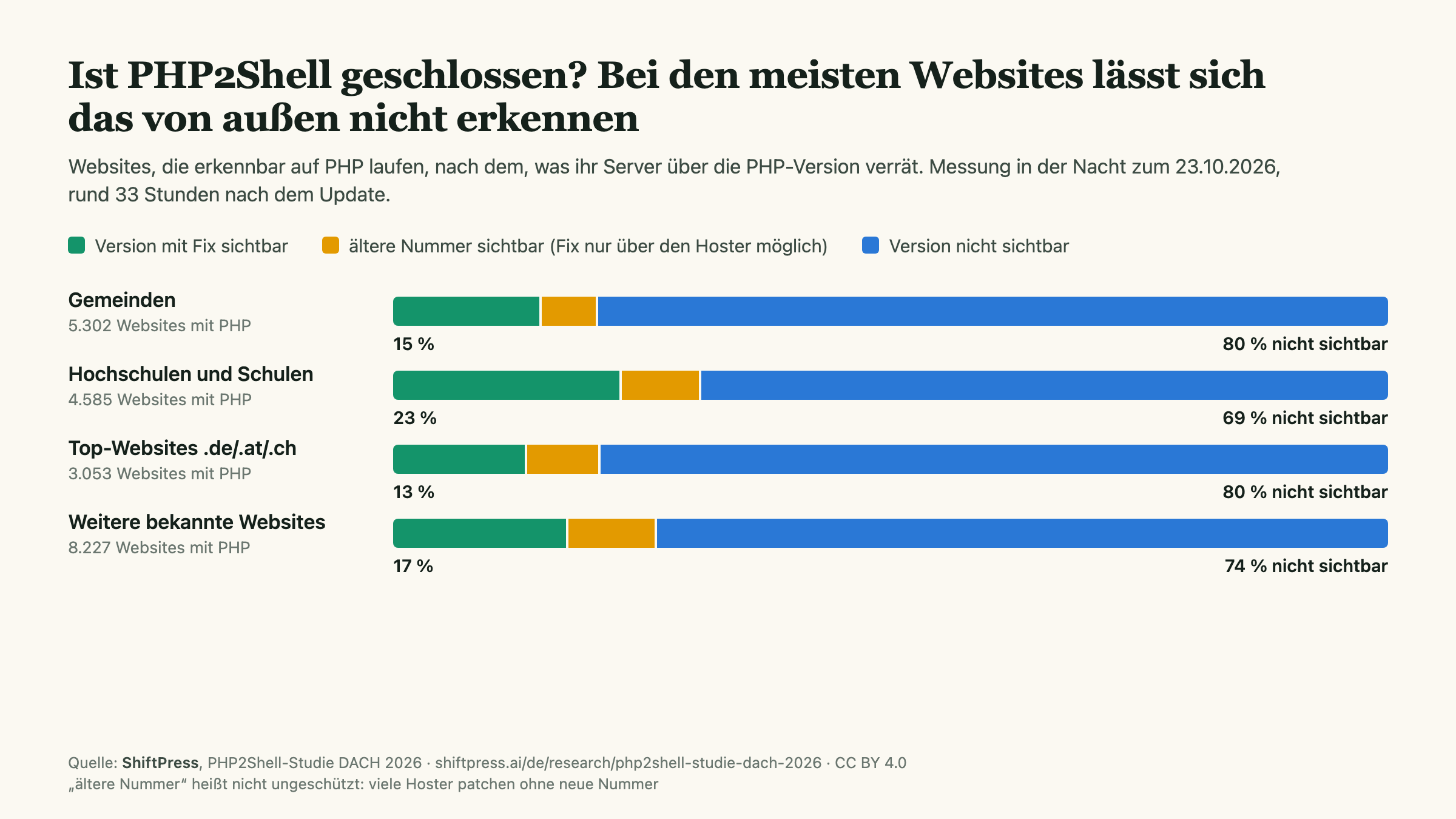
Measured in the night to 23 October 2026 (wave 1). "Version with the fix" means the server reports 8.2.35, 8.3.36, 8.4.27, 8.5.12 or newer. Sites without that number can still be protected, because many hosts built the fix in without changing the number (see below).
One week later: wave 2
On 29 October 2026, eight days after the update, we loaded all 54,743 websites again with the same list. The result: sites on a supported PHP branch caught up. Sites on an old branch stayed where they were.
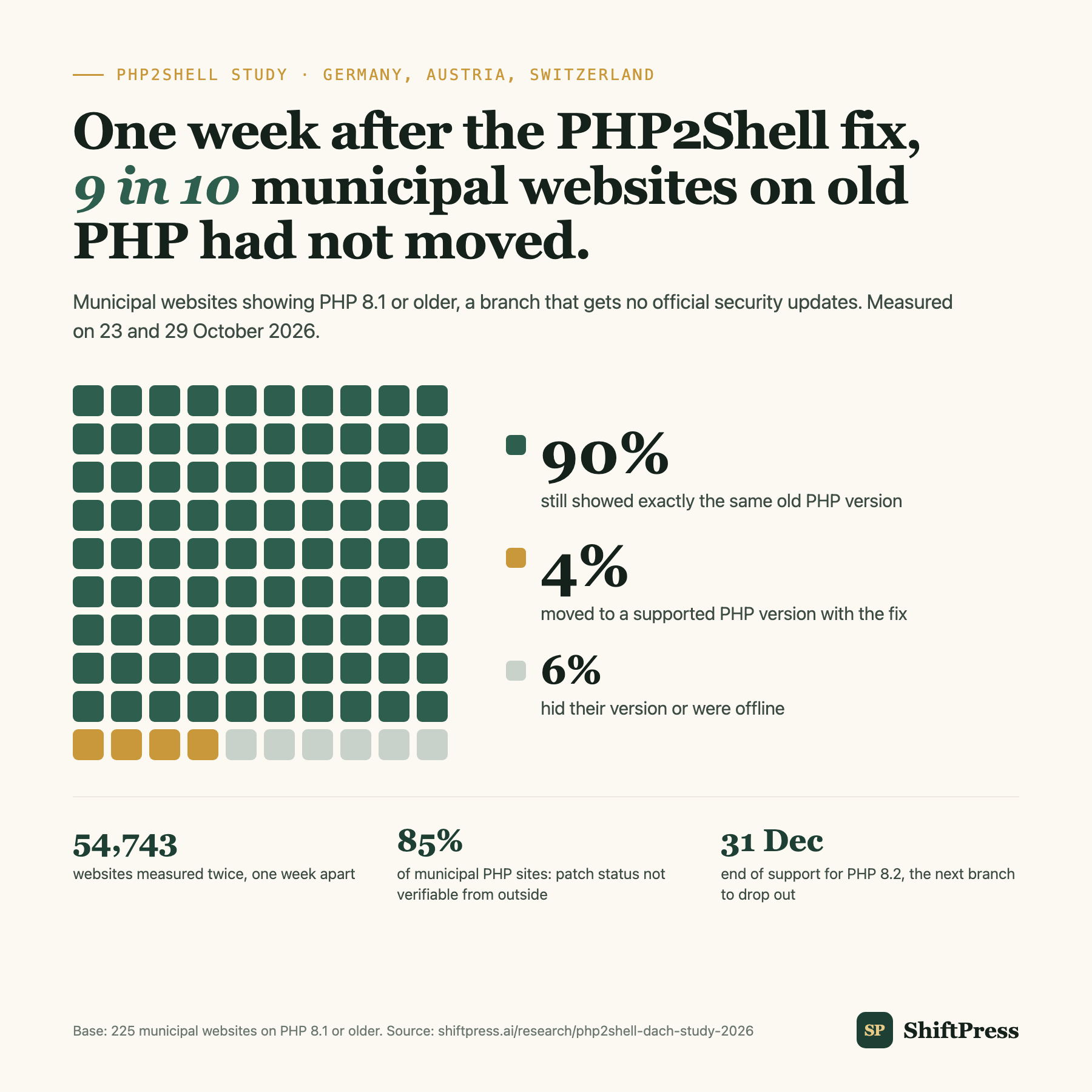
- Hardly any move to current versions. Of the 225 municipal websites that showed PHP 8.1 or older in wave 1, 90% still reported exactly the same version in wave 2. Only 4% now ran a supported version with the fix. Across all groups it was 87% and 5%. The share of PHP 8.1 and older among municipal websites with a visible version stayed at 21%.
- Supported branches caught up. Of the 307 websites that showed an older 8.2 to 8.5 number in wave 1, 83% reported the version with the fix in wave 2. Across all 54,743 websites, only 39 still showed an older number of these branches.
- Still not verifiable. For 85% of municipal websites running PHP, nobody outside can confirm the fix a week later either.
- 36 websites still offline. Of the 57 websites switched off as a precaution in wave 1, 40 were back online and 17 still off. 19 more showed such a notice for the first time in wave 2. In total, 36 websites were offline because of the flaw a week after the update, including 10 municipalities and 12 schools and universities. We checked every hit by hand.
| Group | PHP 8.1 or older (wave 2) | of these unchanged a week later | moved to a supported version with fix |
|---|---|---|---|
| Municipalities DACH | 21.1% (base 1,068) | 89.8% (225) | 4.4% |
| of which municipalities in Germany | 19.4% (892) | 90.7% (172) | 4.1% |
| Universities and schools | 18.2% (1,417) | 87.1% (271) | 5.2% |
| Top websites (Tranco 1 to 10,000) | 24.8% (609) | 84.7% (170) | 5.9% |
| Other well-known websites | 24.4% (2,131) | 85.1% (552) | 5.3% |
Wave 1: key findings
- Not verifiable from outside. Of 5,302 municipal websites that visibly run on PHP, only 782 (15%) show a version that proves the fix. Across all 54,743 websites it is 18%. For all the others, neither a visitor nor the press can see whether the flaw is closed. Only the owner or the host knows.
- One in five shows an unsupported branch. 21.0% of municipal websites with a visible version (95% range 18.7 to 23.5%, base 1,071) report PHP 8.1 or older. These branches get no new official release, only source patches for hosts. For universities and schools it is 19.3%, for well-known websites 26%.
- Hosts were fast. Where a version is visible, 73% of municipal websites already reported a version with the fix a little more than a day after the update.
- Offline as a precaution. At least 57 websites showed a notice instead of their homepage, saying they were switched off because of the flaw: 17 municipalities, 9 schools and universities, plus clubs, shops and forums. Another 9 had switched off single services.
- PHP 5 lives on. 255 websites, 31 of them municipal, still report PHP 5. For it, the PHP team did not even publish a source patch.
Results by group
| Group | reached | PHP visible | with visible version | PHP 8.1 or older | version with fix |
|---|---|---|---|---|---|
| Municipalities DACH | 11,849 | 44.7% | 1,071 | 21.0% | 73.0% |
| of which municipalities in Germany | 7,804 | 47.5% | 888 | 19.4% | 76.0% |
| Universities and schools | 6,642 | 69.0% | 1,404 | 19.3% | 74.6% |
| Top websites (.de/.at/.ch, Tranco 1 to 10,000) | 8,941 | 34.1% | 624 | 27.2% | 64.9% |
| Other well-known websites (Tranco from 10,001) | 21,680 | 37.9% | 2,155 | 25.6% | 66.6% |
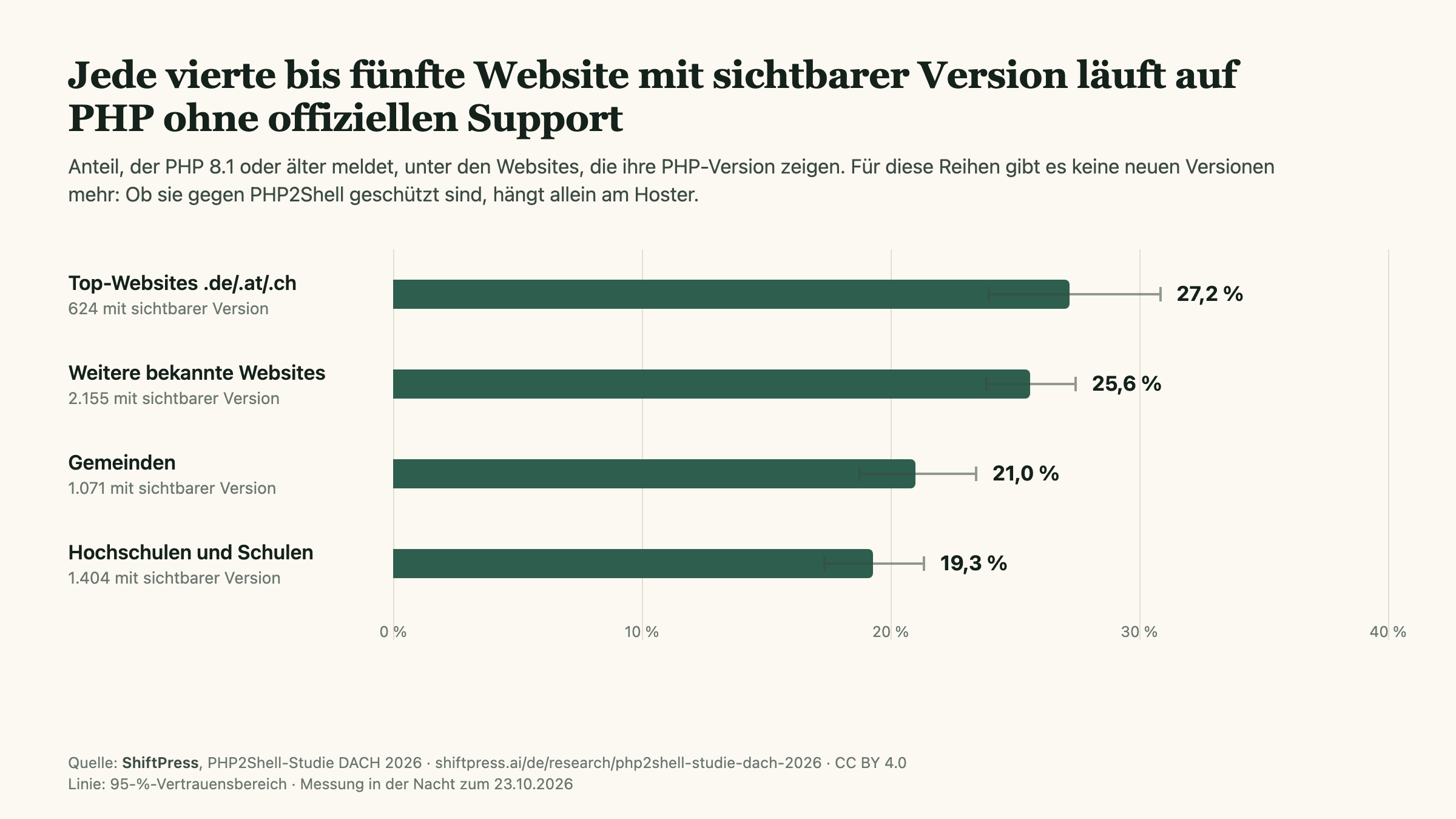
Share of sites with a visible version that report PHP 8.1 or older
Why an old number does not mean "unprotected"
PHP 7.4, 8.0 and 8.1 get no new official release. Many hosts built the fix in anyway, without changing the version number. They say so on their own status pages, for example Hetzner, Mittwald, DomainFactory, netcup, Hostinger and Infomaniak. Hostinger shows how much this shapes the numbers: none of the 38 sites with a visible version we measured there reports a new number, although Hostinger says it patched every version from 5.2 to 8.5.
The "PHP 8.1 or older" share is therefore not a share of unprotected websites. It shows something else: these sites run on a branch the PHP team no longer updates. For this flaw and every next one, their protection depends on the host patching on its own. Support for PHP 8.2 ends on 31 December 2026; then the same applies to another 15% of sites with a visible version.
Taken offline as a precaution
At least 57 websites showed a page saying explicitly that the site was offline because of the flaw. We checked every hit by hand. They include 17 municipalities and towns, 9 schools and universities, clubs, online shops, forums and software vendors. Another 9 websites had switched off single services, such as online forms or a customer area. Sites that simply do not answer are not counted here, because the reason cannot be seen. So the figure is a lower bound. On 27 October, six days after the update, 34 of the 57 websites were back online and 19 still showed their notice.
Late patchers catch up
Since the first wave we load the websites with an older number once a day. Of the 307 websites that showed an older number of the supported branches 8.2 to 8.5 in the first wave, 81% reported the new version with the fix on 27 October (59% on 23 October). We do not count the checks of 24 and 25 October, because our own internet connection failed on those days.
What an emergency update costs
For a website at a host, the update is usually covered by the hosting fee. Whoever runs their own server pays for it themselves. An example: at 0.5 to 2 hours of work and an hourly rate of €95 (median for IT freelancers in the German-speaking region, Freelancer-Kompass 2026), an emergency update costs €48 to €190 per server. The hours are an assumption, not a measurement. Missed maintenance before and the cost of a successful attack are not included.
End of the study
With wave 2 the measurement is complete. We no longer load any websites. As announced, we delete the raw data by 28 November 2026; the aggregate figures stay on this page.
Why this study
Global counts of exposed servers already exist. Numbers for Germany, Austria and Switzerland do not, let alone for groups like municipalities or universities. We want to answer two questions: how many websites still run a PHP version without the fix shortly after the update? And how many of them are unchanged a week later?
Which websites we look at
- Municipalities and towns in Germany, Austria and Switzerland whose official website is listed in Wikidata.
- Universities and schools in the three countries, also from Wikidata.
- Well-known websites on .de, .at and .ch: all of the roughly 35,000 domains with these endings in the public Tranco list of the most visited websites. The first 10,000 are reported separately as "top websites".
How we measure
- One request per website. We only load the homepage, like any browser. We do not guess paths, submit forms or send attack or test code.
- What we read: the HTTP status, the
X-Powered-ByandServerheaders, the names of cookies that are set (not their contents), the generator tag and the page title. We check the page text only for a notice that the site is offline or under maintenance, and why. We do not store the page content. - Visible in your logs: our request identifies itself as
ShiftPress-PHP-Study/1.0with a link to this page. - Gentle: at most one request per second to the same server.
- Two waves: shortly after the update and one week later, with the same list. In between, we load the sites that still show a version without the fix once a day, to see how fast they get patched.
What the version number says, and what it doesn't
The version a server shows is a signal, not proof. Linux distributions such as Debian and Ubuntu often ship
security fixes without changing the number. We recognise those packages by their suffix (for example
8.1.2-1ubuntu2) and count them separately. That is why we speak of versions without an official
fix, never of "vulnerable websites". Sites that hide their version are counted, but left out of the share.
Every figure is published with its base.
Many hosts also patched older versions such as 8.0 or 8.1 without changing the number. An old number therefore does not mean a site is unprotected. We also break the results down by host and check them against each host's own status updates.
We also count sites that were taken offline as a precaution, as some organisations did on 21 October. We only count a site as such when its page says it is offline and names a security reason. A maintenance page without a reason is counted separately.
What happens to the data
- Aggregates only: per group, country, state or canton. We never name individual websites, not even on request.
- Public authorities: municipal websites showing a version without the fix are reported confidentially to the responsible agencies (CERT-Bund at the BSI, GovCERT Austria, the Swiss National Cyber Security Centre), not to the media.
- No sales use: we do not use the study data to contact site owners.
- Deletion: the raw data is deleted 30 days after the second wave.
Leave your domain out
Saw our request in your logs, or would rather not be part of the study? Write to [email protected] with the subject "PHP study: exclude domain" and the domain. We remove it from the collection right away and delete everything we hold on it. Questions about the method go to the same address.
Check your own site
You don't have to wait for the results. Our free PHP2Shell check shows in a few seconds whether your server reports a PHP version with the fix. It only looks at the address you enter, and its results are not saved or used in this study. How to find your PHP version and which version to move to is in How to check and update your PHP version. What PHP2Shell is and what to do now is in our article on the flaw. If you'd rather hand it over, ShiftPress looks after the site for you: you send the change, we do it, you approve it.